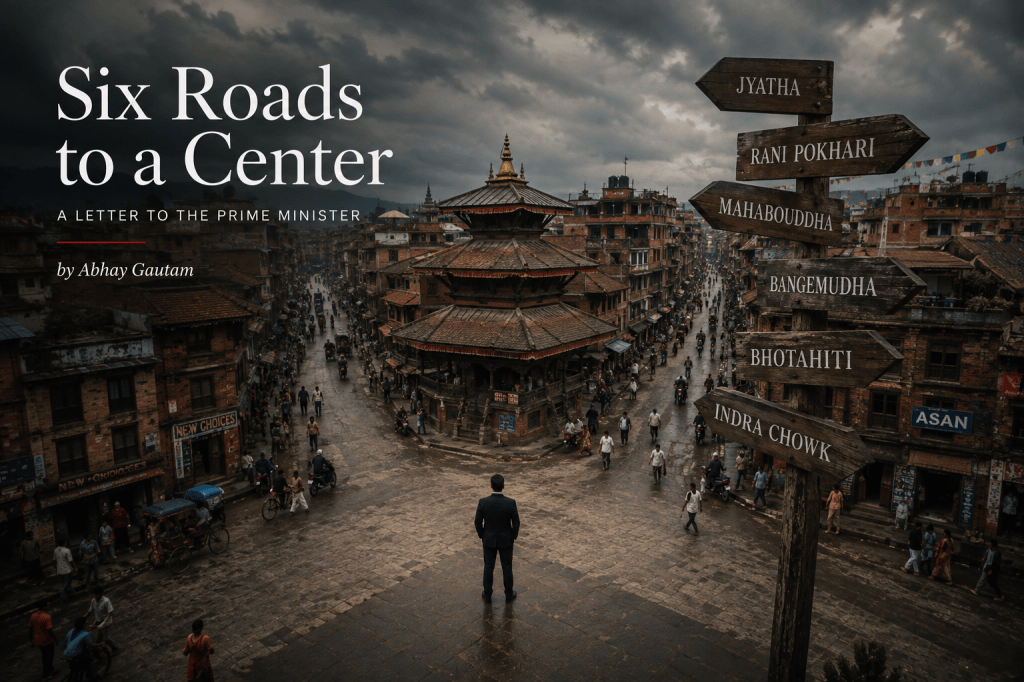
SIX ROADS TO A CENTER: A LETTER TO THE PRIME MINISTER

Prime Minister,

I keep having to correct the word in my head. Six months ago you were the man who fixed Kathmandu’s drains. Now you sit in a chair where Bhimsen Thapa once sat. I don’t know if that’s the fastest promotion in this country’s history, or proof that this country’s history has stopped moving at a human pace. Maybe you don’t know either. Nobody’s had time to ask you.

Our history has mostly been a history of funerals. Some public — kings, palaces, whole systems of government. Some private — one man, one shop, one plate of momo that used to cost twenty rupees. I don’t think you can understand the public ones without sitting with a private one first, so let me start with mine and walk outward until it becomes yours too.

Ugratara temple sits in Asan, six roads meeting at one point, and I used to think that point was the center of everything I’m trying to write about. I was wrong. Asan isn’t the center. It’s the between — the place six different Kathmandus arrive from and leave toward, all at once, all still somehow the same city by the time they get there.

Ghantaghar ko agadi Ranipokhari — that’s the line every child in this city has chanted to decide who goes first in a game, the rhyme nobody remembers learning and everybody somehow knows. In front of the bell tower, the queen’s pond. I don’t know who decided those were the two points worth naming, out of a whole city’s worth of options, only that the rhyme settled there generations before I was born and never moved. Even our games use the map I’m using to write to you.

You know the Rani Pokhari story, or you should. Three and a half centuries ago, King Pratap Malla put his youngest son on the throne, and within days the boy was dead. His queen could not be consoled. Nothing anyone said reached her. So the king dug a hole in the earth big enough to hold a lake, and sent men to fifty-one sacred rivers and tirthas to fill it — water carried from Gosaikunda and Muktinath and further, because ordinary water wasn’t going to be enough for a grief that size. He shaped the whole basin as a yantra, a geometric instrument for peace, and set a stone elephant on the southern bank carrying the king and his sons on its back, the exact weight a father tries to give a mother to hold instead of her son. It still sits in front of Ghantaghar, the Home of the Bell if you translate it plainly, in the shadow of Tri Chandra, the Tri-Moon Campus. Nobody who actually studies or prays there thinks in translation. I do, more than I should. It’s how a familiar place starts sounding like what it actually is.

That’s what a state does with private grief when it has the resources: it turns a hole in one woman’s chest into three hundred and fifty years of public water. I didn’t have fifty-one rivers. I had a shop in Asan, across from a temple, a name on the signboard that isn’t ours anymore, and a plate of momo on Jyatha road that cost twenty rupees when my father took me and fifty now. That’s my Rani Pokhari. Smaller.

Let me walk you the six roads properly, since I’ve already gotten Asan wrong once by calling it the center. It’s six streets, and Asan only sits where they cross.

The first goes to Jyatha, to a shop called Try Again — either a joke or the truest name in the whole market, since that’s what eating there always is, the same plate, the same relief, fifty rupees now, the cheapest plate in this city as far as I’ve ever found.

The second goes to the queen’s pond, past Ratna Park beside it — the Diamond Park, though nobody who’s ever sat on that dead grass calls it that — green in patches, mostly empty, the way a nation’s actual wealth so often sits unused right beside its monuments.

The third goes toward Mahabouddha and the Trauma Centre, through the electric market, past Bir Hospital — the Brave Hospital, patching up whatever the city does to itself this week. Your metropolitan has strung the old wiring underground since I last walked this way and put in those old-style lamps along New Road, and it’s a smaller thing to thank a Prime Minister for than a throne, but I’ll thank you for it anyway. I don’t walk this street as easily as the others, though. My actual trauma doesn’t stand at the temple. It stands there, at the Centre, where my father died on a ventilator, unable to move, unable to speak, except through his eyes.

The fourth bends toward Bangemudha, past the trunk where the toothache tree used to stand — nail a coin into it, the legend goes, and the god takes the ache with him. Ugratara keeps its address on that same road, my father’s temple, and he once kept his own office in front of it too — Nine Planets, a jyotishi’s shop, where he read other people’s birth charts for a living and never once, that I can remember, told me mine. He learned Sanskrit as a boy in Tehrathum, forgot it the ordinary way a life forgets things, and relearned it as a grown man after he found Vipassana — ten days of silence at a time, sitting with everything he’d spent a life running from. A man who spent his final years walking toward stillness, in a shop that has someone else’s name on it now. He named me Abhay — fearless — and I now work for a company called Coldfeet. I used to think that was the joke life was playing on me. I don’t anymore. I think it’s just what inheritance actually looks like: you don’t escape your father’s contradictions, you get issued a new costume for the same argument.

The fifth goes to Bhotahiti, the old book market, where I once bought a novel — Ghanchakkar, a word that means, roughly, a mind spinning too fast to land anywhere — and came home saying, out loud, to my own family, that this country needs to talk honestly about its throne again. They told me I wasn’t well. Maybe, given what the book’s title actually means, I wasn’t. But I want to tell you where that particular madness actually started, because it didn’t start with me and it didn’t start with a novel.

It started on the first of June, 2001, in a palace most of us had never been inside, when a royal massacre ended a dinner and, within it, an entire dynasty’s claim to have died a natural death. Officially, we know what happened. Few in this country have ever fully believed the official version, and I won’t pretend to either, so I’ll leave it where the street leaves it: some call it a mystery, some call it a curse finally arriving on schedule — the old Gorakhnath prophecy, the one that gave this dynasty exactly ten generations on the throne before it ended, and if you count them out from Prithvi Narayan Shah, the tenth would have come due right around then. A nation doesn’t grieve a mystery the way it grieves a fact. It just keeps circling the hole where the fact should be. Seven years later the monarchy was gone entirely, abolished by the same exhausted country that couldn’t stop asking what actually happened at that table.

The doubt never actually closed, and this year, of all years, it was reopened by one of us. Sudan Gurung, the DJ who ran a nightclub before he ran a protest movement, the man most responsible for putting you in Bhimsen Thapa’s chair, took his own chair at the Home Ministry and announced, among his first acts, that every old file in this country would be reopened — the Narayanhiti file included. Whether that promise survives contact with this country’s usual patience for its own unfinished business, I don’t know yet. Nobody does. But the fact that the reopening came from the same movement that ended the last government, and not from a royalist or a historian or a court, tells you something about where the real authority to ask that question now sits.

So when Singha Durbar burned on the ninth of September — the Lion Palace, in plain English, has burned exactly twice in its history, once in 1973 for reasons nobody has ever fully explained, and again that September, in my own lifetime, while the country you now run was busy being born in the streets outside it — the whole country watched Kathmandu turn itself inside out. I remember the strange, nervous laughter that went around, the joke everyone made and nobody quite meant, that the old man himself, Gyanendra, might come walking back through the smoke to pick up what was dropped in 2008. He didn’t, of course. Lions don’t come back with a bang. They come back with anniversaries, and speeches on Democracy Day that stop just short of asking outright, and a signature campaign that started this month and is still collecting names.

The loudest voice in that campaign right now isn’t a general or a priest or anyone with a title. It’s Manisha Koirala — yes, that Koirala, granddaughter of the very man whose party dedicated itself to making sure no king ever ruled here unchecked again — standing at a podium saying, in effect, that she learned from her own grandfather that a constitutional crown is what protects this country’s soul, that a republic without one has spent seventeen years failing to give us the identity we were promised. I don’t know if she’s right. I know that when the granddaughter of Nepal’s first elected Prime Minister is the one making the strongest public case for bringing a king back, the old categories — royalist, democrat, left, right — have stopped meaning what we think they mean, and somebody in your position is going to have to say something about it before the signatures finish collecting themselves.

Because here is the actual choice in front of you. There have been two kinds of men who’ve stood where you’re standing now. One went to England as a young Prime Minister of this country, was received by a queen, fell for a courtesan named Laura Bell, and spent a fortune he didn’t personally earn on diamond rings and a house in Belgravia to keep her comfortable while Nepal waited for him to come home. The other, decades later, also became Prime Minister of this country — briefly, imperfectly — and spent the rest of his life writing psychological novels so unflinching that people still argue about what he was actually confessing. One man spent the nation’s grandeur on his own appetite. The other spent his own interior life trying to understand the nation’s.

You are thirty-six years old, with an army now. I don’t know which of those two men you already are. I know which one I’d like you to become.

The sixth road is the one I’ve been putting off, and it runs, appropriately, to New Road — despite the name, the oldest road in this whole letter — and from there straight to Hanuman Dhoka, where Prithvi Narayan Shah sat on the throne in 1768 after Kumari herself put the tika on his forehead, and where every king after him was crowned in the same courtyard, generation after generation, until the year the crowning simply stopped. That courtyard is still standing. Empty, structurally sound, and waiting for someone to tell it, definitively, what it’s for.

Because if that campaign collects its signatures, someone is eventually going to ask you the question sitting underneath all my other questions: who?

The name people reach for is Hridayendra — it translates, appropriately, to king of hearts. He was born on the thirtieth of July, 2002, the same year I was, which makes us both, by every definition anyone uses for the phrase, Gen Z. He was two years old when his grandfather seized direct power. He was five when the monarchy ended under him before he ever got the chance to sit in it. He has spent the years since studying abroad, mostly out of the country’s daily sightline, which in Nepal is its own kind of political education — you learn what a country wants from you by how loudly it misses you. If Nepal ever puts a king back in that courtyard, it may well be handing the crown to someone who has never once cast a ballot in a Nepali election, and who belongs, on paper and by birth year, to the exact generation that just finished burning down the last government for failing them. A Gen Z uprising, reaching backward for a Gen Z king. I don’t think anyone planning that signature campaign has fully sat with how strange that actually is.

His own father, by most accounts, never much wanted the job either — crowns have a way of skipping the son a country doesn’t trust and landing on the grandson it hasn’t had the chance not to trust yet. I won’t pretend to know if this country is ready to let that be the whole answer. I do know that if it ever is him, he will be exactly what you are: young enough to have spent his whole life watching this Republic fail to become what it promised, and standing there, if he ever does, only because a Gen Z uprising put him within reach of it — the same uprising that put you in Bhimsen Thapa’s chair. That is either the strangest coincidence in this country’s modern history or the least surprising thing about it. I genuinely don’t know which, and I don’t think you fully do either. Nobody’s had time to ask.

I found a hundred rupees on a dark road once, in Kirtipur, the night I climbed a wall at midnight and walked out of a ten-day Vipassana course I’d lasted five days inside — silent, starving, no phone, no money, both locked away with the rest of my belongings the day I arrived. My father spent his last years walking toward exactly that kind of stillness. I spent one night that year walking as fast as I could away from it, through Asan, into Thamel, the district built for forgetting. Same temple standing between us both times, twenty years apart, neither of us telling the other where we were actually headed. I bought a packet of wai wai and a bottle of water with that hundred-rupee note and kept walking until the city let me back in.

That’s the whole lesson I have for you, if you want one. This country keeps finding just enough, right when it’s about to run out, and it keeps walking. Whatever you decide about kings and thrones and who sits in which courtyard next — go and eat a plate of momo on Jyatha road. Fifty rupees. Cheapest plate in Kathmandu, as far as I can tell, and it hasn’t let the city’s cruelty touch it yet. I would like, more than almost anything else I could ask a Prime Minister for, to watch you eat there and mean it.

Unhinged sadness

Personally, I do not like to talk about depression. A successful man might say, it is essential for growth. Newspapers print ‘tips’ to ‘fight’ depression. Of course, there are chemicals available in the market that stabilizes your mood and emotions, makes you happy, as a poet said somewhere, “euphoria packaged in a box.”

I’d love to try those antidepressants someday. For me, depression is one of those bizzare human problems. Not bizzare in the sense that I’m disregarding it, but everything that leads to a person getting depressed, the circumstances, the hurt; everything is absurd. This is also to say that existence is absurd, society is absurd, culture is absurd and so is human relationship.

That was a bold thing to say. Another bold thing to say is “Mothers can be a bitch” to someone who worships every mother. Camus urges to embrace absurdity like it’s a beautiful thing, something to be loved, as if it’s not mere disorder in one’s little inner world that conflicts with the disorder of outer world every long day.

Well, what is depression then? Just a bad word like every other not carrying the feeling(now more than ever). I think depression is boring and just, sad. If I was a good poet, I’d compare it with a fairy hiding a black rose. Who lives inside a deep well whose head is also too tall that one needs a ladder to peek through. You cannot climb the well without denying the black rose. It shatters when one looks at the face of anxiety. Many people get hurt and start hurting others. I just couldn’t do it.

It’s like a scar that must be hidden. Like some dirty secret.

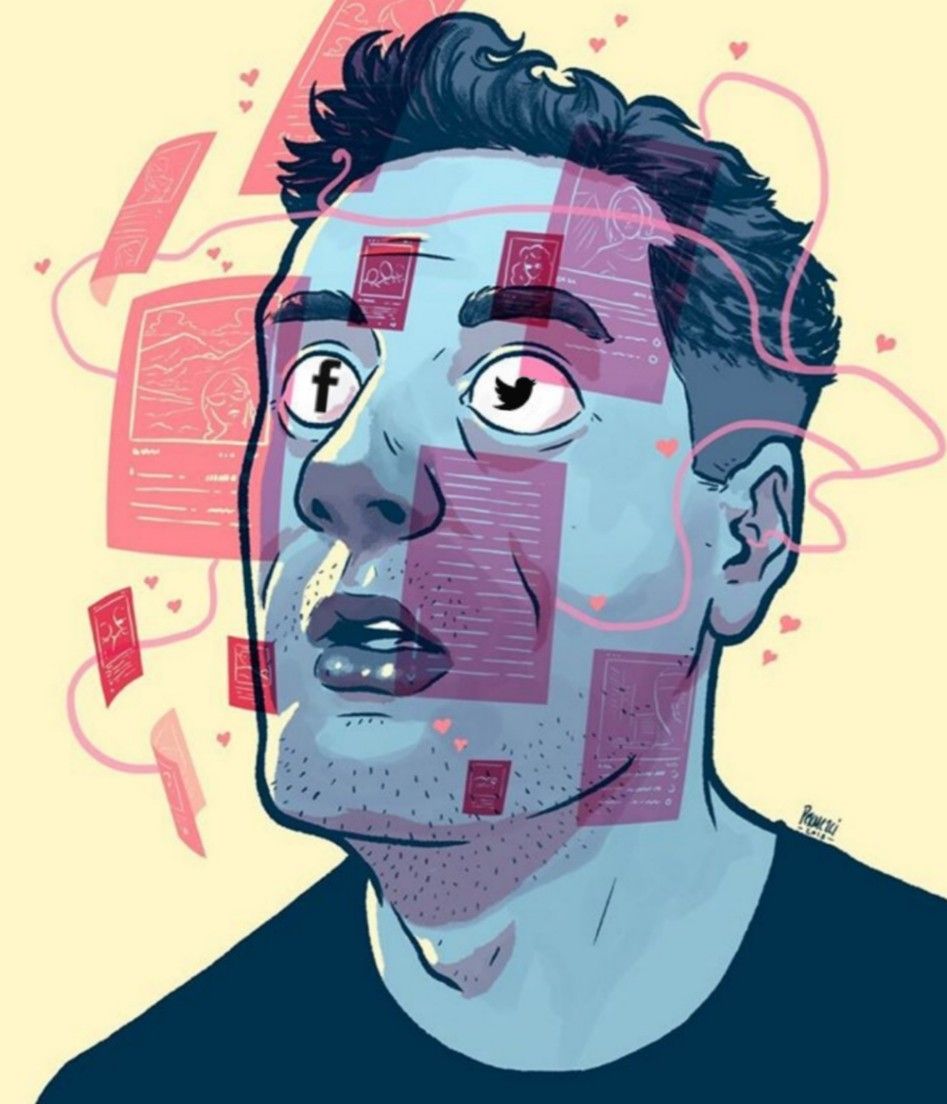
Sadness is also scrolling a screen. You know the world is going crazy when people are dying to get viral unironically. When you can’t stand anything anyone says, when you don’t have the guts to reply a message, when you can relate to nobody but the constant chatter inside your head, it’s loneliness. There are easy and good escapes to loneliness, like being rude and having hobbies, worshipping a god, having fun and earning money and so on. There are moderate escapes such as drugs, alcohol, abuse and sex. Perhaps the hardest escape is suicide, but an escape nonetheless. You cannot pretend you don’t see the ugly.

Sometimes I think about an imaginary little french girl in the 7th century who is crushing the purple grapes with her feet to make wine, inside a decorated wooden vessel, smiling. Each evenings, I imagine her touching leaves of bushes as she returns to her house after glaring at the sunset for 5 minutes or so. I try to watch the world with the aesthetics of her blue eyes and everything that’s reflected there. Then, depression meets me again.

People say happiness finds you. Sadness finds you too.

A book simply doesn’t get completed without sorrow and grief. Maybe except if it’s about economics. Modern economic science ignores suffering like a lion who who ignores other zebras after devouring one of them. Maybe humans wouldn’t have to feel so inferior by birth for their parents being poor or unhappy, if the plain contraction of ‘judgement’ didn’t exist. Even if there is no judgement, the illusion of it exists. Sorrow comes with agony to children and never leaves them. We just learn to accept it and continue to act ‘normal’.

I don’t know how to end something like this. I couldn’t face words, I suppose? A conclusion is just a supposition, and one can only conclude when there’s clarity. Sadly, I do not possess any clarity. One can only be so much clear about life and it’s elements. But I wanted to say I’m not frustrated with depression. Neither I am obsessed with it. I cannot express it in words. I don’t think anyone can. I fell in love once, even though I was never loved, even if I didn’t know what love was. And then my love was humiliated. Not that it was the only thing that was humiliated. Depression comes and goes. Anyway, the past will disappear someday. The flowers will grow and ‘I’ will be happy again.

Thoughts

and the saints think
just to realize
it doesn’t thinks at all
triggered by
common knowledge
sometimes drunk,
a distant memory,
come thoughts

Thoughts
triggered
by the voice of my lover
through the passage of the thinker
the man in the mind that
thinks that
He’s just like
the mirror

he shakes when he fears
and smiles himself in pleasure
he dances around the town
and captures himself in measure

It tells you that it’s
Somebody else
To preserve itself
Myself
Yourself
Ourselves

And the saints strive
to find the triggers
but the layers are too deep
And holding a thought
equals to
holding a breath

Life is anything you name it

Life is anything you name it. Join some fancy words together. Even simple words work,  like life is simple, life is a rain, life is pain, life’s a game. I like how people say it is a struggle, or hardship. Of course, it is the thing to which we put most of our time, efforts and thoughts on but hardship can’t be life. Not when you see the aesthetics of a cat’s life! It cannot be a dream because life has been there for a long time before the mankind’s life came and some guy, for the first time, thought about life. It might have been a little girl perhaps.

The world is brutally real. We’re not sure about our inside world yet. The epitome of philosophy is sometimes the hatred for some feelings a human can feel, how uncaring the world is and why the fuck life evolved into human consciousness? Philosophy might be finding the truth, but the truth is realized only when the thinker reaches there and the reader reads it. This means that the unrealized truth has a little significance in solving the real problem, the truth being problematic itself. Some think it was cooked food that made humans conscious. Some say it was love. Most believe it is a divine god that sent us in this strange planet. All that matters is we’re not sure for now.

We came, we saw, we conquered. It wasn’t easy getting hold of the world. We had to see for ourselves, if it wasn’t fairies who give superpowers that we can get, it should be power. Everyone loves power. We like to be powered upon too, it proves when there should be an authority above each. Its not a bad thing I guess, cuz when men are free, men want to fight. The outer world was gotten hold of, through merciless killings and the power of hands and animals. But the inside world was still an animal. A profoundly confused animal. Human couldn’t kill his/her thoughts. We did what was necessary to survive better. We grew up, made houses and stuff, built self worth and the need for a bigger house. We started struggling more. For the caveman’s life was to kill a prey that would feed the group for a week and relax. The agricultural age man had to plough the field all day. He would better starve. For life was secure now. Survival and conditions shouldn’t be judged anyway.

The acclaimed acedemic Yuval Noah Harari  says agricultural revolution was the biggest mistake we ever made. I love that one line in his book which goes, We did not domesticate wheat, wheat domesticated us. I find it funny too because weed had domesticated me at some point. Then we made some art, wrote poems, built empires with mostly sad subjects, saw some foolish kings, and finally the English made the engine. The industrial revolution is just too gloomy and grey to talk about. One can still see it on the black hands of a labour, his family and his life. We weren’t that significant until then, then we destroyed the earth. We could now do things that a hand couldn’t with efficiency. You  know, I agree with the philosophy that says all our experiences, perceptions, memories, sorrow, emotions, thoughts and that one center that we call our heart, is the same, the framework of our thought. The content of our consciousness. And it’s uniquely different for everyone. But the human suffering that has the major part of the whole of human consciousness is the same and it is that makes us think; we still haven’t realized that in a meaningful way. If the majority of us had, there wouldn’t be countries, modern economic science or religions for that matter. We are the image of nature weeping for itself. The essence that creates this image is us. We are our imaginations and our cravings for pleasure, our fear for the unknown. Everything that’s present in the world is either done for pleasure or punishment. Some don’t get punished, some don’t find pleasure. There are exceptions everywhere. Go where it takes you. Introduce your catastrophic personality to yourself in a way that makes you beautiful, interesting and modern again. That’s a line I stole from the tv series ‘Mad Men’. We’re not all mad men. But I believe aliens would think we are.

The gen Z is almost fucked

There has been cognitive, agricultural and industrial revolution in humanity’s history from 60000 years. And somewhere around 40 years ago, there was a new “Information” Revolution. It has just been over a decade that people started using Internet in this part of the world. Though post millennial generation and gen Z is the first one in all of human history to have such immense access to information as a kid, we’re also the gloomy ones.

Somewhere in the context, we have misunderstood Internet. We’ve misused it more. A whole lot of us might have not used the search button in a while. Still, what is there to search about? Because Google gives you readymade answers. Because Facebook gives you ads that you’re thinking about. Because YouTube wants you to repeat videos. It’s alright, we’re all fighting with technology. I’m a victim myself. There’s a lot of people on Internet, and wisdom is very rare. The research is very short. There’s a lot of content that can fuck you up. We don’t know where to go, which information to process and  there’s so much to it in fragments. It’s more about passing time than it is about showing off on Internet. Then again, we get bored there. The major issue is that our psyche and our love is massively influenced by the apps and games, we become dull and strange, the kids love their mobile more than the garden now.

Why does it seem so hard to imagine life without Internet to us?  Cuz we’ve lived there, we’ve been outside and jumped and danced while throwing off smiles of joy. Someday, we’re going to be the last batch of humans that knew how life was like before Internet. In a more profound way, how the mind was like before Internet. Because you know, people used to hold thoughts and analyze, compare, draw conclusions, understand before they run away. Today, the gen Z’s thought is like of a Facebook’s news feed, we just scroll over them, faking a laugh, and fighting with thoughts, we cannot take anything seriously. We feed on cringe. We laugh at misogyny. We start conversations with wicked motives. There shouldn’t be motive in love. We fantasize, be fans of people and then, criticize. The problem with Internet is that, it shows that how much different one is from other in every way possible. We’re a generation that likes to be a little different from everyone, but altogether the same.  We share what the cool kid shares, we find funny what s/he does. We start to think like the friends we add, the people we follow and the way recent trends in memes flourish we feel like our days have changed but it’s always many days like one. A lot of thought comes to our mind at the same time, thanks to all the information. And we sort between them really fast, cuz you know, you gotta say something always. You have to halt a  conversation sometimes.

Thought used to be slow but honest. 50 years ago, people would most probably be happy or sad on a single thing. They would analyze thoughts through their own speculations and reach to a conclusion. The modern teenager does not analyze thoughts but it reacts to them almost the same way it reacts to posts. Whatever emotion, feeling or insecurities the reaction triggers the mind, we draw a conclusion based on that. Our conclusions aren’t necessarily false or bad, they’re cute instead, but they are misleading to oneself. The question is, do we even read for pleasure anymore? A lot of little children who would have read for pleasure may not ever read because of social media. Here, we read for fun or nothing. We read every single thing perhaps expecting a laugh. Or just to not let the monster of the modern age get some time for itself, the monster is boredom. We’re really silly to be honest. The person who’s reading this upto here is a real woke person. You are not the only ones that can save the world from this catastrophy, in a post pandemic world, but you’re the better type. One needs to educate it’s mind with truths and facts even though truth is rare. A true information revolution is awaiting, while we make path for the spiritual revolution.

किस क्रान्ति!

(१)

“एउटा कुरा भनुम्?”

“अँ, भन न। ”

“मलाई तिम्रो असाध्यै माया लाग्छ।”

“अनि?”

” तर तिमीलाई खुसी राख्न सक्दिनँ की भनेर डर पनि लाग्छ। “

मौनता एकछिन केही बोलिन, अनि सुयोगको आँखामा हेर्दै भनी, “म खुसी छु तिमीसँग।”

मौनता र सुयोग १ वर्षदेखि रिलेशनशिपमा थिए। सुयाेगले उसमा र आफूमा अ लट इन कमन देखेर फेसबूकमा प्रपोज गरेको थियो। मौनता भने अझै पनि प्रष्ट भिन्नताहरू देख्दथि।

तर मौनताको प्रेम उसको नाम जस्तै थियो, कहिलेकाँही डरलाग्दो अनि धेरैजसो शान्त। अनि उसलाई सुयोगले सुरुसुरुमा ‘माई मिस्ट्री गर्ल’ भनेर पनि बोलाउँथ्यो। सामान्य कुरालाई मान्छेहरूले आफ्नै पाराले बंगाएर भनेको सहन गार्हो हुन्थ्यो उसलाई, सायद त्यसैले होला अनायासै एकदिन भनेकी थी,”म तिमीभन्दा धेरै गरीब छु, सुयोग। मैले गरिबीलाई नी ,यति भोगेको छु कि, त्यो तिमी बुझ्नै सक्दैनौं के।”

सुयोगलाई के भन्नु के भन्नु भको थ्यो। घटना र कुराहरूलाई विशेषण दिन उसलाई राम्ररी आउँथ्यो तर आफू कसको घरमा जन्म लिइन्छ भनेर थाहा नहुनुको ट्रेजेडीलाई कुन वाक्य फाल्नु? त्यो माथि उसलाई मौनताले बन्देज लगाएकी थिई बिहे बारे कुरा गर्न। सोचेर भनेको थ्यो उसले, “ट्राई गर न त, बुझाउ मलाई कस्तो हुन्छ गरिबी।”

त्यो सुनेर मौनाताले मज्जाले व्यंग मिश्रीत मुस्कान दिएकि थी। मुस्कान सेन्स गरेर हो की, उसको छेउ एउटा सेतो कुकुर आएर बस्यो। झण्डै गर्व गर्दै उसले भनेकी थिई त्यो बेला सुयोगलाई,

“मरेको मुसाको गन्ध बारे बुझ्न चाहन्छौ कि चाहनाको कम्प्रोमाइज बारे? गरिबीमा थुप्रै आयाम हुनछन् यार, मैले भनेँ त तिमी बुझ्न सक्दैनौं भनेर। मैले भन्न खोज्या यत्ति हो की तिम्रो खुसी भन्दा मेरो खुसी सधैं थोरै हुनेछ ।”

“अँ, तिमी दुःख डिजर्भ गर्दैनौ त्यैपनि जिन्दगीले दियो, के गर्नु त? तर मैले प्रिभिलेज पाए भन्दैमा मेरो खुसी तिम्रोभन्दा ठूलो अनि मेरो दुःख तिम्रोभन्दा सानो छैन, बुझ्यौं? मैले पनि धेरै कुरा भोगेको छु।”

मौनता फेरिपनि मौन बसेकी थिई।

(२)

त्रिभुवन विश्वविद्यालयमा झमझम पानी पर्दै थियो। विद्यार्थीहरुलाई मौसमले च्यालेन्ज दिएकै थियो र चुरोट र ठो को बास्ना सँगै कीर्तिपुरका साना पस: हरुमा जङ्गिदै थियो राजनीती, दर्शन, व्यापार अनि मार्क्सवाद। तर, कसैले पनि कसैलाई भेटिरहेका थिएनन्। गोलो चक्रमा घुमेकै घुमाई हुन्थ्यो त्यो बहस, अनि विरक्त त त्यतिबेला लाग्थ्यो जब आफूलाई आफैले सही भन्ने विद्यार्थीको भन्दा पनि अर्काको विचारलाई तुच्छ भन्दिने विद्यार्थीको स्वर झन् चर्को हुँदै जान्थ्यो।

त्यस झरीमा एउटा अविरल जोडी भने रुझ्दै थियो, तर रोमान्टिक भएर होइन। मौनता र सुयोग दुवैजना छाता बोक्ने खालका मान्छे थिएनन्। अझ, अरुलाई माग्नु त पाप लाग्थ्यो उनीहरूलाई!

पानी झन् ठूलो भएपछि उनीहरू पनि दौडिँदै एउटा बिल्डिङ्ग मुनि गएर ओत लागे। मौनता आफ्नो कपाल सुकाउन थाली अनि सुयोग आफ्नो टी सर्ट खोलेर पानी निचोर्दै थियो। त्यतिकैमा मौनताले सुयोगको ढाडमा छोएर आँखा नझिमक्याई भनेकी थिई, “सुयोग?”

“हजुर?”

“आज सेक्स गरुम न।”

“हस्,माई लभ, तिमी भन न मात्र।”

“अब धेरै बोलेर मूड नबिगार है”, भन्दै मौनता आँखा चिम्म गरेर उभिई। ऊ पहिलो पटक सबमिसिभ भएकी थिई।

सुयोग बिस्तारै उसको फिक्का ओठ तर्फ अघि बढ्यो र उसलाई मज्जाले चुम्बन गर्यो। “दिस इज द बेस्ट किस एभर”, दुवैजना मनमनै सोच्दै थिएँ।

तर त्यो दिन मूड बिग्रिनु नै रहेछ। भाषिक संकाय अन्तर्गतका एक प्रोफेसर त्यही बाटो हिड्दै रहेछन्। उनीहरूलाई देखेछन् र उनलाई के लाग्थ्यो भने त्यो नै अमर्यादित व्यवहारको पराकाष्ठा हो। यता मौनता र सुगामले कता जाने भनेर प्लान बनाइसकेका थिए। उता प्रोफेसर शर्माले आफ्नो प्रिय विद्यार्थीलाई उनीहरूलाई आफ्नो अफिसमा डाक्न फोन गर्दै थिए।

(३)

“मेरो यौनिक स्वतन्त्रता माथि दखल दिने के हैसियत राख्नुहुन्छ तपाईं?” मौनता प्रोफेसर शर्माको मुख देखेर अनि उसको आरोप सुनेर रिसले आगो भइसकेकी थिई। सुयोग भने केही बोल्न सकिरहेको थिएन। उसलाई पनि खै के ले थिचेर हो, ठूलो गल्ती गरेको आभास भैरहेको थियो।

“यो नेपाल हो केटी बुझिस्, अमेरिका हैन। हाम्रो आफ्नै संस्कार र संस्कृति हरु छन्। विद्या लिन आउने ठाउँमा त्यस्तो काम गर्ने हो, छि छि छि छि,झन् यो त नांगै थियो,तिमीहरूको बुद्धि।” प्रोफेसर मौनतालाई मौन पार्न चाहन्थ्यो।

“तपाईंले आफ्नी श्रीमतीलाई कहिले चुम्बन गर्नुभएको छैन जस्तो लाग्यो सर, र यदि छ भने पनि म्याडमलाई खासै मन परेन होला।” सुयोगले आँट गरेर मुख खोल्यो।

प्रोफेसर शर्माले बिस्तारै आफ्नो आँखा झुकायो र आफ्नो टेबुल बाट एउटा फाइल झिक्यो। “साला हिप्पी हरु”, गनगनायो आफैलाई।  मौनता फाइलको नाम पढ्न खोज्दै थिई। सुयोग डर र चिसोले काँपिरहेको थियो। प्रोफेसरले आफ्नो अँध्यारो अफिसमा रातो मसी भरिएको कलम झिक्यो र आफ्नो सही गर्यो। र, भन्यो, “तिमीहरू दुवैजना १ महिनाको लागी निलम्बित भएका छौं, यो नै आधिकारिक नोटिस हो।”

“माफ गर्नु होला सर, हामीले तपाईंको मुटुलाई दुखाएको भए, तर यो युगमा किस गर्यो भनेर सस्पेण्ड गर्न पाइँदैन।” मौनतालाई सीधा आँखामा हेर्दै भनी।

“पाइँदैन रे, भइसक्यो। यो राम्रो व्यवहार र सङ्केत होइन अनि तिमिसँग म छुट्टै कुरा गर्छु, मौनता। तिमीहरू त झन् खुसी हुनुपर्ने, १ महिना टाइम देको छु हनिमुन मनाउन।” प्रोफेसर शर्मा आफ्नो कुर्सीबाट उठ्यो र उनीहरूलाई अगाडि बढ्न इशारा गर्यो।

मौनता शान्त रहन सकिनँ। उसले भन्दै थिई, “के तपाईंलाई आफ्नो व्यवहार  सधैं मर्यादित लाग्छ सर? यो पनि? कस्तो मान्छे यार तपाईं…”, तर यति भन्दै गर्दा उसका आँखा रसाए। उसले आफ्नो मुख आफै बाङ्गिन थालेको महसुस गरी। उसका हातखुट्टा गल्दै थिए।

सुयोगले मौनतालाई आफूतिर तान्यो र नरुन भन्यो। उनीहरू पछाडी फर्किए र ढोकासम्म पुगे पछि सुयोगले अर्कै टोनमा टाउको घुमाउँदै भन्यो, “शर्मा सर, वि विल फाइट यु।”

(४)

मौनताले कहिल्यै पनि आफू प्रेमको लागि क्रान्ति गर्ने स्थानमा पुग्छु भनेर सोचेकी थिईन। तर, उसलाई समयले एउटा मौका दिए जस्तो लाग्यो। उसले सम्झी आफ्नो बाल्यकाल हाम्रो आफ्नै मिड सिक्सटिक्स तिर, जतिबेला जताततै प्रेमवादको प्रश्नचिन्ह कोरिएको हुन्थ्यो। तर, उसको मानसपटलमा भने त्यो एउटा बिजुलीको पोलको दृश्य घुमिरह्यो जसमा प्रश्नचिन्ह थिएन।

क्रान्ति सजिलो हुँदैन रहेछ। र, छोटो पनि। मौनता र सुयोग त्यो घटना पछि सबैभन्दा पहिला विद्यार्थी संघको अफिसमा गएका थिए। त्यहाँ उनीहरूको कुरा त सबैले सुने तर केही गर्न कोही तयार भएनन्।  किसको लागि लड्ने हाम्रो राजनीति होइन, सिधै भनीदिएको थियो एउटाले।

त्यसपछि उनीहरूले निलम्बनको कानूनी जायजता बुझ्न एकजना वकिललाई खोजे। वकिल एकदमै मृदुभाषी थियो। उसले भने अनुसार कानुनले विश्वविद्यालयमा गरिने किसबारे परिकल्पना गरेको थिएन। “तर, सार्वजनिक स्थानमा किस गर्न अझै मनाही छ र यो कानुनलाई बदल्न सक्ने तागत तपाईंहरुको केसमा छ। तपाईंको योगदानलाई भविष्यका पुस्ताहरुले सम्झिनेछन्, तपाईंहरू प्रेमको सिम्बोल बन्नु हुनेछ।”

दुवैजना मस्किए। वकिल फेरि बोल्यो,  “तर तपाईंहरूले मुद्धा दायर गर्न सम्भावित कारण चाहिन्छ। भन्नुस्, प्रोफेसर शर्माको बारेमा के के भन्न सक्नुहुन्छ।”

“पहिलो त उसले हामीलाई नराम्रो शब्द प्रयोग गरेको छ, अनि म रुँदा पनि उसले कुनै संवेदना देखाएन।”, मौनताले भनी।

“हामीलाई हिप्पी भनेको थ्यो सर त्यसले, अनि हनिमुन जा पनि भनेको थियो।”, सुयोगले शब्द भन्यो।

“आई सी! ल, तपाईंहरू अहीले दर्ता दस्तुर र एड्भान्स पे गरेर जान सक्नुहुन्छ। लडाइँको दिन तय भएपछि म हजुरलाई सम्पर्क गर्नेछु। र, चिन्ता नलिनुस्, यो कुनै ठुलो लडाइँ हैन।”

सुयोग र मौनता आश्वस्त थिए। तर, दुवैजनाले घरमा भनेका थिएनन्। मौनता नभन्ने सोचमा थिई। उनीहरूले वकिलको दस्तुर मिलेर तिरे र फुटपाथमा पुगिसकेपछि सुयोगले मौनतालाई चुम्बन गर्दै भन्यो, “टु द रिभोलुसन अफ किस, जय किसक्रान्ती।”

(५)

मुद्धा चल्यो। पूरा ६ महिना चल्यो। प्रोफेसरको वकिलले सुयोग अर्धनग्न अवस्थामा रहेको र वहाँको यौन जीवनमा प्रश्न उठाएको कुरामा धेरै जोड दिएपछि न्यायाधीश पनि थोरै उतै तिर ढल्केका थिए। मौनताको वकिलले बेलाबेला मन जिते पनि पूर्वीय सभ्यताको कुरा निस्केपछि फेरि गार्हो भइहाल्थ्यो। र, मुद्धा निलम्बन भन्दा बेसी सार्वजानिक स्थानमा प्रेम व्यक्त गर्ने पाइने स्वतन्त्रता सम्बन्धी थियो। प्रोफेसरले मौनतासँग छुट्टै कुरा गर्ने भनेको प्रसङ्गले मात्र उनीहरूको केस चलायमान थियो।

पाँच महिनापछि मौनताले अति भएर सामाजिक सञ्जालमा आफुले गरिरहेको किसक्रान्ति बारे पोस्ट गरी। घर छिमेकले थाहा पाउलान् भन्ने डरले उनीहरूले सो गरेका थिएनन्। सुयोग भने डिप्रेसनमा थियो।

सञ्जालका भित्ताहरू चाँडै किस क्रान्तिको समर्थनले ढाकिए।कतिले मिम बनाए र कतिले कविता। एउटा जमातको आलोचना पनि उत्तिकै थियो। आर्टवर्क, बहस, ह्यासट्याग अनि केसको समाचारले दुई तीन हप्ता शहरी युवा धेरै हौसिएका थिए। ती मध्ये केहीले अभियान नै चलाए, किस गर्दै गरेको फोटो पोस्ट गर्ने। र, त्यसले कति सहयोग गर्यो या गरेन त भन्न सकिँदैन तर अन्त्यमा किस क्रान्ति सफल भएरै छोड्यो। मौनता र सुयोगले लडेको त्यो ६ महिनाको लडाइँले गर्दा देशमा अब किस गर्नु अपराध थिएन।

मौनता र सुयोगलाई अविरमाला लगाइयो। वकिलले भने जस्तै उनीहरु प्रेमको सिम्बोल बनेका थिए। दुवैजना आफ्नो संघर्षको कथा सँगै सुनाउन पाउँदा असाध्यै खुसी थिए। तर चर्चा न हो, सेलाइहाल्छ। अर्को महिनामा उनीहरुलाई सबैले बिर्से र वर्तमानको वास्तविकता अप्ठ्यारो थियो।

सुयोगको बाउ छोराले आफ्नो बचत खाताको सबै पैसा वकिललाई बुझाएको थाहा पाएपछि की त घर की त मौनतालाई छोड्न दबाब दिँदै थिए। एउटालाई छोड्ने बित्तिकै उसको जीवनमा जाने कुनै ठाँउ बाँकी हुँदैन थियो। मौनतालाई त झन् भन्न पनि सकेको थिएन।

धेरै सोचेर उसले एउटा पक्का निर्णय भेट्यो मनमा, सुयोग घर छोड्न तयार भयो। मौनतालाई फोन गरेर भन्यो, “क्रान्ति गरियो, अब फेरि गरिबीमा फर्कौ, माया। मैले तिम्रो लागि घर छोडेको आज बाट। अब बुझाउ मलाई गरिबी, लग मलाई कतै।”

“हरे शिव, म कता लग्नु तिमीलाई?”

“हामी सँगै पहाडतिर बस्न जाउँ, की त शून्य लगानी लिएर पैसा कमाउन थालौँ। के भन्छौ?”

“म जान्छु तिमीसँग, पहाडतिर।”

एक क्षणको लागि सुयोगको खुसीको कुनै सीमा थिएन। त्यसपछि सीमाहरू आँफै निर्माण हुन थाले। त्यति नै बेला मौनताले भनी, “अब बल्ल हाम्रो सुखदुःख बराबर हुनेछ।”

लकडाउन नैराश्यता

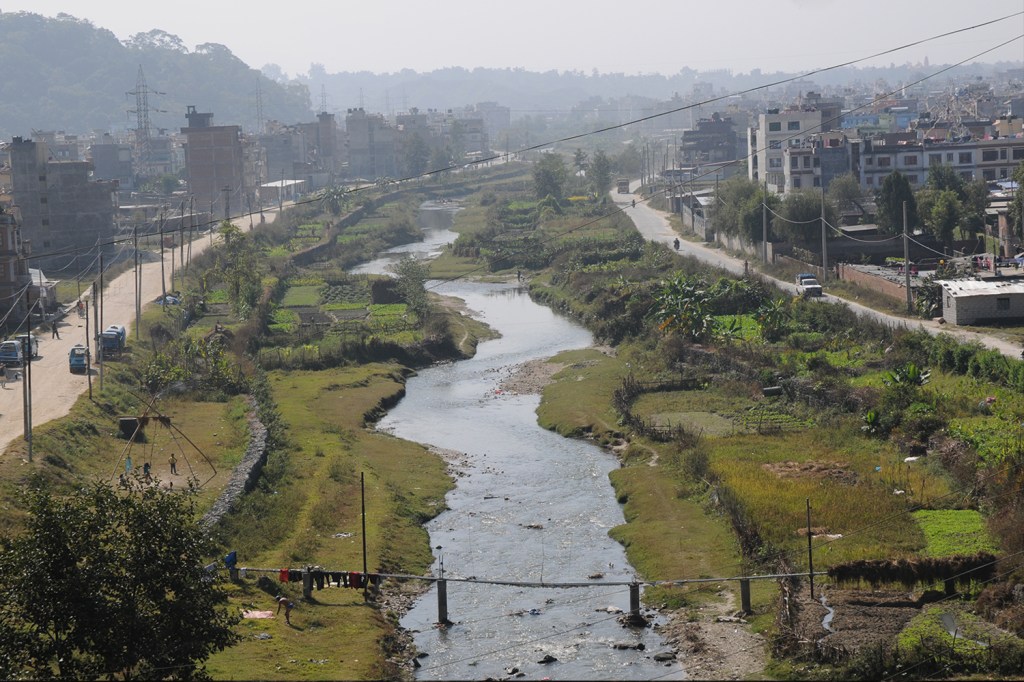
थाहा भएकै कुरा हो, देश लकडाउनमा छ। आकाश र आँशु निरन्तर वर्षिरहेकै छ। मानिसहरू निराश छन् र पसलहरु बन्द छन्। सबैलाई चिन्ताले सताएको छ तर यो कुनै नयाँ चिन्तन पक्कै हैन। हरेक व्यक्ति जीवनमा निरन्तर आफ्नो आत्म-छविको साख जोगाउन लागि पर्छ। उसको सामाजिक प्रतिष्ठा, धन सम्पति, स्वास्थ्य, बालबच्चा र उसको नशा, यी सबै उसको आत्म-छविलाई विस्तार गर्ने पूरक तत्व हरु हुन। र, लकडाउनले व्यक्तिको आत्म-छविलाई नराम्ररी धक्का दिएको छ। उसको सम्पूर्ण जीवन खतरामा छ र ऊ आज केही पनि गर्न सक्दैन किनभने केही गर्नुको अर्थ उसको भ्रमको पर्खाल भत्काउनु हुनेछ। यस्तै कुराहरू मनमा खेलाउँदै एउटा योगी बागमतीको किनारमा हिँड्दै थियो।

थापाथलीबाट टेकु सम्म आइपुग्दा उसले बाटोमा थुप्रै मान्छे देख्यो। कोही सूर्य चुरोट खान घरबाट निस्केका थिए, त कोही घामको किरण टाउकोमा ठोक्काउन लाई। हुन पनि हो, योगी सोच्दछ, अँध्यारो कोठामा बस्नेलाई घाम पनि एउटा आवश्यकता हो। आफू भित्रको अँध्यारो देख्न नसक्ने मान्छेले उज्यालोको स्वरूप बुझ्दैन।

योगीको कुनै गन्तव्य थिएन। न त ऊ भोकाएको नै थियो। हिजो राती ऊ एक पोका सुख्खा चाउचाउ खाएर मसानघाटमा सुतेको थियो। जति नै खाली पेट भए पनि उसले कहिले खानेकुरा मागेन। योगीलाई आफू प्रति गर्व त थिएन, तर ऊ अरु मानिसलाई आफूभन्दा विमुल्य भने पक्कै सोच्थ्यो। पिपलबोट पुग्नै लाग्दा उसलाई कसैले बोलायो, “ओए जोगी, कता हिँडेको, मास्क खोइ तेरो?”

“मैले समाज बाट दुरी कायम गरेको छु सर, र म यो खोलामा पर्ने अर्को मसानघाट जाँदै छु”, योगीले पछाडि नफर्की जवाफ फर्कायो। त्यति भन्ने बित्तिकै नाङ्गो तिघ्रा मुन्तिर भाटा खायो। त्यस एक क्षणको पीडालाई उसले आफूभित्र यति सोस्यो की त्यो पीडा अर्को क्षण कम्पन सकेन। ऊ आफ्नै सुरमा अगाडि हिड्यो। उसलाई भाटा हान्ने निराश प्रहरी जवानले जोगीलाई होल्डिङमा राख्न उपयुक्त ठानेन। सायद जति कुटे पनि नरुने आफ्नो छोरालाई सम्झेर पो हो कि!

योगी खोलाबाट माथि मूल सडकमा उक्लियो र देख्यो शून्य सहर। पर पर सम्म कोही थिएन। उसले वरिपरिका भवनहरू हेर्यो जुन एकछिन हेरिरहे पछि ती घरहरू अपरिचित जस्ता लागे। “यस्ता डब्बा जस्ता कोठाहरूमा कसरी बाँचेको हो मेरो प्रजाती? सोच र मानिस एक्लै कोठामा थुनिँदा अन्तिममा आउने परिणाम पागलपन नै हो र? मलाई पनि सबैले पागल नै भन्छन् तर मूर्खहरुले निर्माण गरेको समाजमा सबै पागल हुन्छन् जुन अस्वस्थता समाजले चिन्दैन।” योगीले सोच्यो।

खोलाको छेउ हिड्दै गरेको योगीको भेश अरुबेला भन्दा भिन्न थ्यो। उसले आज धेरै पछि कालो गेरुवस्त्र धारण गरेको थियो। मुजा परेका भएपनि उसको मुहार उज्यालो देखिन्थ्यो। पछाडी आफै भाङको बोटले सिलाएको सानो झोला भिरेको थियो जसमा पानीको बोतल र केही नोट थिए।

बाटोमा उसले थुप्रै जन्तुहरुलाई देख्छ। आफू छेउ आएका कुकुर हरुलाई सुम्सुम्याउँदै गर्दा उसको अगाडि एउटा सेतो रंगको पुरानो कार आएर रोकिन्छ। चालकले उसको छेउमा गाडी रोकेर बिस्तारै झ्याल खोल्दै गर्दा योगी केही नबोली उभिएको थियो।

“प्रणाम बाबाजी, जय शम्भो!”, सुटमा सजिएको चालकले आफ्नो कालो चस्मा र मास्क नखोली योगीलाई नमस्कार गर्यो।

“नमस्कार, महाशय, किन हजुरको साधन रोक्ने कष्ट गर्नुभएको होला?”

“म निराश छु, प्रभु! यत्तिका वर्षमा मलाई निराशाले छुन सकेको थिएन। भित्र आउनुस् न, म हजुरलाई पुर्याइदिन्छु, बरु एकछिन गफ गाफ नी गरौं!”

योगीले थोरै अप्ठ्यारो माने पनि अन्त्यमा कारको पछाडिको ढोका खोलेर भित्र पस्यो। भित्र चुरोटको गन्ध भन्दा एयर फ्रेशनरको गन्ध अलिक बलियो थियो। चालक ४०-४५ उमेरको हुनु पर्दो हो, योगीले सोच्यो।

“हजुरले कति वर्षको हुँदा मोह त्याग्नुभएको प्रभु?” चालक कुरा र गाडी अगाडि बढाउँछ।

“त्यो आवश्यक छैन होला, बरु तपाईं किन निराश हुनुहुन्छ भन्नुस् न, म सक्ने जति सहयोग गर्नेछु”, योगीले जवाफ फर्काउँछ।

“अरु मान्छेहरू भेट्न नपाउँदा मलाई मानिस बन्न गार्हो भइरहेको छ बाबा। मैले मेरो सफलतालाई फर्केर हेर्दा विशाल देख्ने गरेको थिए तर आजकल त्यो सफलताले मलाई बिझाउँछ।”

“तपाईंको घर परिवारमा कोको हुनुहुन्छ?”

“मेरी श्रीमती, अनि एउटा छोरी छे अष्ट्रेलियामा। यहाँ चाहिँ दुईजना मात्र बस्छौ। म लकडाउन अगाडि सारै व्यस्त हुन्थे, सबैले ज्यू नमस्कार गर्थे, मेरो काम मात्र सोच्नु र निर्णय लिनु हुन्थ्यो। अहिले मसँग सोच्नलाई काम पनि छैन र मेरा पुराना सोचहरु रुमल्लिदै छन्। मैले यति धेरै कुराहरु आफू भित्र दबाएको रहेछु जुन अहिले आएर प्रस्फुटन हुँदै छ।”

“कस्तो सोचको कुरा गर्नुभएको?”

“घिनलाग्दा सोचको, जुन एकचोटि सोचिसके पछि निराशा बनेर मनमा टाँसिन्छ। के मेरो सम्पूर्ण सफतला भन्दा मेरो छाडापन र बाल्यकालका नमिठा सम्झना ठूलो छ यो दिमागलाई?”

“तपाईंको दिमाग मैले बुझ्न सक्दिन। मैले भन्न सक्ने यति नै हो, तपाईंको मन शान्त छैन। शान्त पार्न चाहनुहुन्छ भने मैले जस्तै घर परिवार र सम्पति त्याग्नु होस् । र अहीले, यही क्षणमा निर्णय लिनुहोस् नत्र मलाई यहाँ अगाडि सम्म छोडिदिनु भए हुन्छ।”

चालक अगाडिको खाली सडक हेर्दै टोलाउँछ। आफ्नी श्रीमतीलाई सम्झिन्छ अनि आफ्नो घरको सबै कोठाहरु दिमागको कोठाबाट चिहाउँछ। उसलाई ती स्मृति खैरा र निरस लाग्छन र आफुले जीवनमा गरेका कपट सम्झिदै गर्दा ऊ विरक्तिन्छ।

“म सांसारिक मोह ह्वात्तै त्याग्न तयार छु प्रभु, भन्नुस् कहाँबाट सुरु गरौं?”

योगीलाई खाइलाग्दो व्यापारीले संसार त्याग्ने कुरा गरेको सुनेपछि अचम्म लाग्यो। “सुरुमा यो गाडी बाग्मतीमा हुल्दिउँ न त?”, योगीले हाँस्दै भन्याे।

चालक तथा व्यापारी धर्मसंकटमा पर्यो। खोलामा हाल्दिम भने आफ्नो पहिलो कार, नहालुम भने योगीको आदेश। उसले अन्त्यमा आफुले जीवनभर गर्दै आएको काम गर्ने सोच बनायो, बार्गेनिङ। अझ राम्रो सुनिने गरी भन्नु पर्दा, नेगोसिएटिङ।

“म यो गाडी त फाल्न सक्दिन प्रभु, तर मेरो मन मेरो शरिरलाई बाग्मतीमा कल्पना गर्दै छ। मैले आफूलाई जति सुकिलो भएको
सोचे पनि यो लकडाउनले मेरो मगजको मैलो उजागर गरिदियो। मैले बाग्मतीमा हाम फाले भने मेरो मन र आत्मा फेरि पवित्र हुन्छ त प्रभु?”

योगीलाई व्यापारी बडो रोचक लाग्यो। मनको मैलो फाल्न बाग्मतीमा शरीर हुल्ने हिम्मत भएको मानिस भेटाउन वास्तवमै गार्हो हुन्छ। तर योगीलाई परवाह थिएन। उसले भन्यो, “तपाईंको मर्जी, तर म केही पनि ग्यारेन्टी गर्न सक्दिन। सबै कुरा तपाईंमा नै भर पर्छ। मात्र एउटा कुरा याद राख्नुहोस, तपाईंको सोच र तपाईं भिन्नाभिन्नै कुरा होइन।”

“म बुझ्दै छु, प्रभु, म सबै कुरा बुझ्दै छु।”

“के बुझ्दै हुनुहुन्छ?”

“की मेरो अरु मान्छेलाई हेर्ने दृष्टिकोणमा ठूलो खोट रहेछ। मेरो सबै विश्वास मात्र मेरो अनुमान रहेछ, त्यस्तै त्यस्तै”

“यो महान् खोज हो महाशय, अझै आफू भित्र डुब्दै जानुस् तर कुनै पूर्वाग्रह वा सिद्धान्तलाई नसमात्नुस्, केही नयाँ कुरा पत्ता लाउनु छ भने तपाईंको भुतमा नअल्झिनुस्।”

“थ्याङ्क यु, बाबाजी, धेरै प्रेरणा दिनुभयो हजुरले। अब भन्नुस् कहाँबाट खोलामा छिर्दा ठीक होला?”

“मैले भनिसकें, तपाईंको मर्जी हो।”

“ल म ऊ त्यो ढुङ्गाबाट छिर्छु।” व्यापारीले आफैलाई सन्तोष दिने मुस्कान सहित योगीलाई औंलाले ढुङ्गा देखायो।

व्यापारीले झाडी र सडक छुट्टिने ठाउँमा लगेर कार रोक्यो। योगी कारबाट बाहिर निस्केर खोला तिर हेर्दै टोलाउन थाल्यो। व्यापारी भित्र आफ्नो चस्मा, सर्ट र प्यान्ट फुकाल्दै थियो। उसको मनमा एउटा छुट्टै उमंग जागेको थियो, मनको मैलो पखाल्न पाउँदा। र, मञ्जुश्री छेउको बागमती खासै फोहोर पनि थिएन।

स्यान्डो र बक्सरमा व्यापारी बाहिर निस्क्यो र योगीलाई हेरेर मुस्कुरायो। योगीले पनि मुस्कान फर्कायो अनि आँखाले अघि बढ्न अनुमति दियो। व्यापारी दौडिँदै खोलातिर गयो र खुट्टा चुर्लुम्म डुबायो। अनि सोच्यो, मैले बाग्मतीमा मेरो टाउको डुबाएर दिमागलाई खाली गर्नुपर्छ। खोला गनाएको उसलाई अलिकति पनि असर परेको थिएन। ऊ आज पहिलो पटक मुक्त महशुस गरिरहेको थियो। उसले लामो श्वास भित्र तान्यो र नमस्कार गर्दै खोला भित्र पस्यो। १ मिनेट पानीमा बसेर बाहिर निस्किँदा योगी र उसको कार गायब भइसकेका थिए।

Top 5 smartest animals and how people are like them

Some animals are really smart by human standards. ‘Animal type’ can be a thing, like a primate version of the whole personality type thing, and there are more options to choose from. It’s just that some distinctive characteristics of these creatures match way too more with humans.

The animals I’m about to list is going to be from the top 10 and no offence to all the smart animals out there. We only know a little about how they think because we can only examine their outer behaviour. And who knows better than humans that how big the inner world can be.

5. Elephant

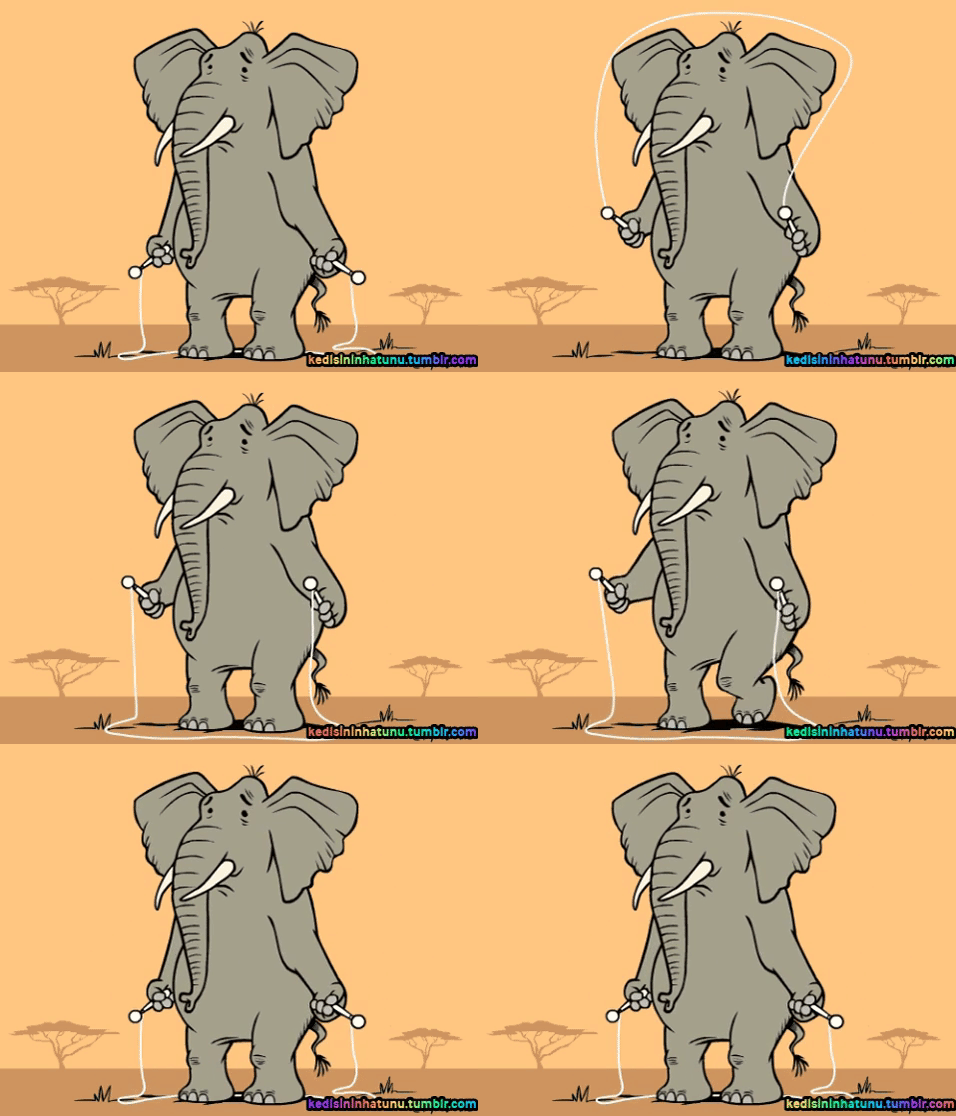
Everyone loves elephants. It is nature’s majestic creation, the only great thing that’s harmless. They represent kindness, gentleness, a big heart and massive memory. They understand that every individual is unique. Not only they show empathy, compassion and honour, but they also have funerals. Elephants are what
emotions are all about.

And even though elephants have a bigger heart and brain than anyone else out there, they’re afraid to express or approach it, because elephant people accept authority without a single doubt. They do what they’re told. They’re wounded by love. They do not like to be rude to people who hurt them. They do not like to think that the world isn’t perfect. They’re loyal to the wrong people. They’re sweet but vague.

The memory of intelligent life on earth is stored in the genes and images of the elephant’s mind and humanity might be a deadly prick in that memory. But they do find us cute. No one can truly understand an elephant person, they can get aggressive sometimes but their aggression can be justified, most of the times.

4. Pigs

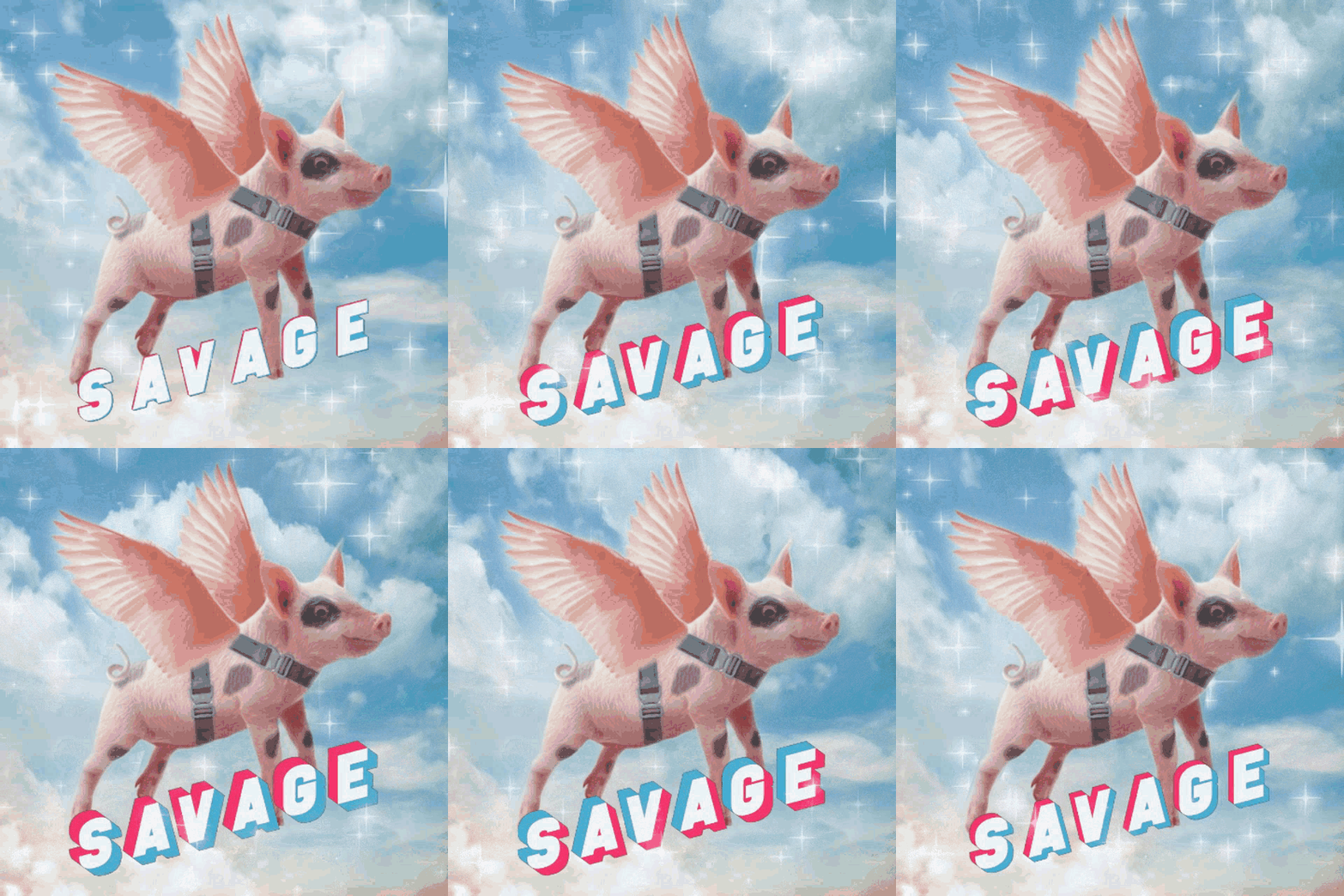
The pig is the 4th smartest animal. And pigs are just like the blunt significance of the 4th position and how it is ignored. The pig represents the misjudged and ignored people. They are the ones with a clean heart but people believe it’s dirty. They self-pity themselves. It is said that the pig is ashamed of its tears. Once it’s ashamed, there is no meaning to life. There’s no confidence. Pigs are shamed and humans are too because we laugh when we think of pigs flying.

Our skin are eyelashes are almost like pigs. They are the smartest of all domestic animals. And of course, there are sweet cow people, the sheep people and the innocent chicks misbehaved by their so-called owners but they ain’t smart. There’s a poem about a pig by Roald Dahl that thinks about life and kills its owner. Only because the pig understood he was going to make bacon of her. People are made bacon of in corporations.

Pigs have the intelligence of a 3-year-old child. They’re social and intelligent, but something about the pig always seems off. It’s the same with most people. It is the blissful ignorance that those pigs and men enjoy the lazy boredom.

3. Crow

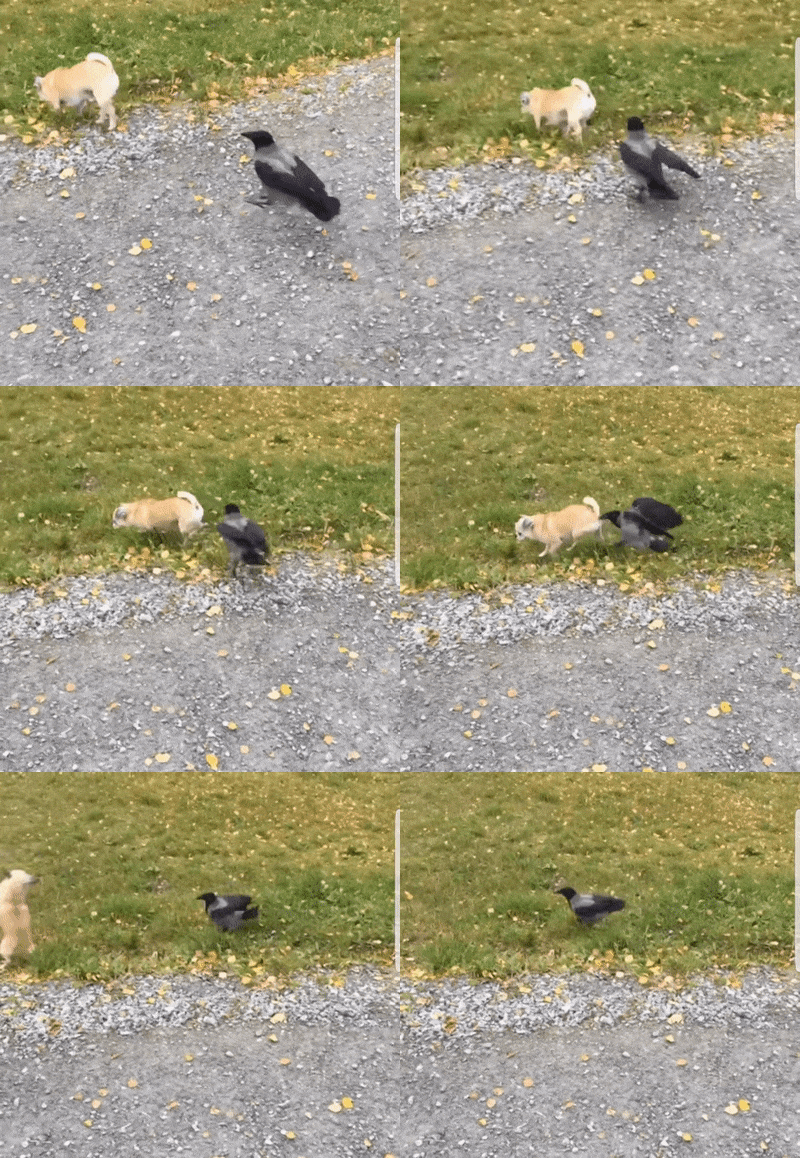
The intelligence of a crow can be compared to that of a 7-year-old human child. It is the smartest animal because it thinks of the future a lot, communicates abstract concepts, remembers people and cars for years and takes revenge on them.

Crow people are pricks, jerks and shitheads. They have a strong sense of self awareness and pride. They cannot put themselves in the next person’s position. They do not try to understand and feel other people’s feelings. They do not get hurt easily and when they do, they blame someone for it.

Crows have been observed to use some tools better than chimpanzees. They’re not a bit shy to ‘caw’ loudly. Crow people derive satisfaction from domination. They like to bully and pull others down, just to fancy their own self image.

2. Rat

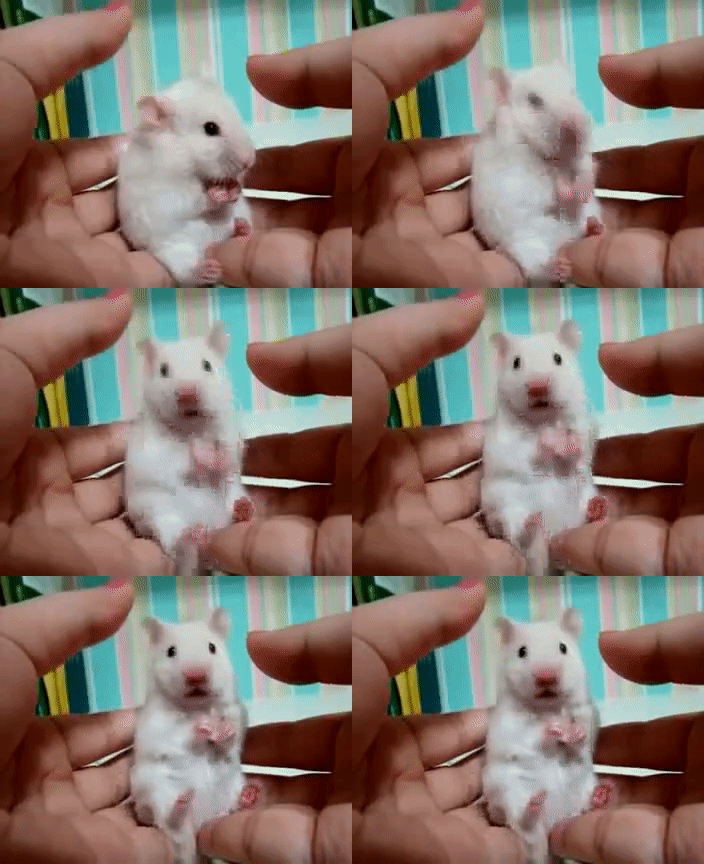
Rat is the animal that has colonized every continent in the world. Humans have placed them in Antarctica too. Rats can differentiate between the good and bad (of their world) which is a difficult concept even for humans. They’re the survivors. They’ll run and bite and hide their whole life for survival. The rat represents the poor man, the loathsomeness he holds, and how unfortunate they’ve been.

The rat person is born in a mess. He’ll only learn what he sees from the grassroots economic status, which is the constant fading of morale. And no one can blame the rat for there’s no such thing as opportunities for it. It is deprived of love, possession and respect since its birth. The poor man is powerless. He doesn’t care how he is governed because there’s only one aim in his life, to have food on a plate for the next night. There are always little problems in life still.

Rats are honest indeed, creative in their day-to-day job and conversations, but they’ve got a quick temper and they’re wasteful. The essence of a rat person’s life lies in the bottom of the glass of the drink he takes that night. He sees his reflection, and doesn’t like it, then wants the glass to be filled again. We’ve all seen dead rats and drunk people who sleep on the road. They’re essentially the same.

1. Dolphin

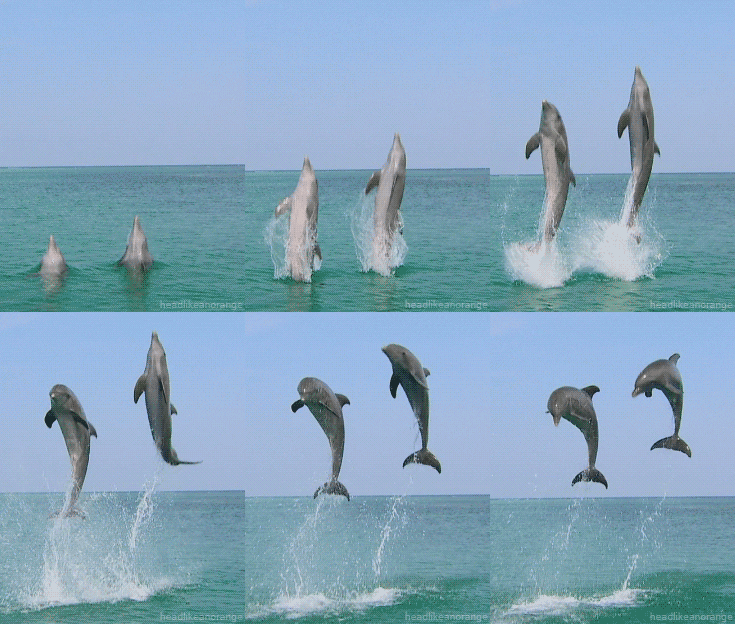
Dolphin is the perfect animal. It’s intelligent, curious, social and has a good sense of humour. Dolphins are magnificent and they know how to feel themselves in the water but most of all, they’re at peace with themselves.

People who are like dolphins are very rare but they do exist. They’re the ones who can give unconditional love. They’re the artists of their own life. They understand what makes them human, or dolphin. They live in perfect harmony between the water and the air, which is simply the sadness and happiness of the inner world. Dolphin people are filled with wonder and joy, and they have the purest smile.

There’s a dolphin inside everyone. But we rush to make something expected of our soul and heart that seems nice but isn’t us. Just like we rush to fall in love, we rush to imitate others. Every human being has to explore and find out who he/she is for oneself, no one in the world can help. The world would be a lot better if human beings realize the dolphin or the goodness inside them.

Thank you so much for reading! I wish the animal inside you vitality and satisfaction. But there’s no animal inside you. You’re the animal. Just kidding, you beautiful bloody bastards!

Break up

A moment to breathe
between smokes
A lover’s hand
soft replica of emotions
fear and pleasure
her smile holding the wine
as elegant as
posture of her hand
as the
ashes fall
she takes the last puff
as the eyes slowly
close themselves
she laughs at the counter man
It wasn’t told to her and me
the secrets of human relationship
we did not imitate rudeness
We knew they didn’t
feel enough
they couldn’t take enough
she imitates me
I imitate her
she asks for the bill
and tells me
“Let’s split”
“The bill only?”
“No.”
she replies.


Nothing

We’re nothing in front of
Divine ladies who often get
Mistaken for sluts
Their genuineness becomes
Too much
Or, perhaps, their smiles
May be too ‘lovely’ and ‘sweet’
For toxic men to handle

We’re nothing in front of
A beggar’s child
A saint-to-be
A collapsed house
A white man’s dream

And we become nothing
If one looks at the mirror
for half an hour
If one stops to see a tree
Without a stupid thought in mind
We’re nothing in front of
The reflections looking back

Though we strive hard
To be something to show the world
It’s still by the world’s standards
Everyone other than me
Has the same sorrow, more or less
It is still a dark, dark night
Nothing  to be seen inside