
Prime Minister,
I keep having to correct the word in my head. Six months ago you were the man who fixed Kathmandu’s drains. Now you sit in a chair where Bhimsen Thapa once sat. I don’t know if that’s the fastest promotion in this country’s history, or proof that this country’s history has stopped moving at a human pace. Maybe you don’t know either. Nobody’s had time to ask you.
Our history has mostly been a history of funerals. Some public — kings, palaces, whole systems of government. Some private — one man, one shop, one plate of momo that used to cost twenty rupees. I don’t think you can understand the public ones without sitting with a private one first, so let me start with mine and walk outward until it becomes yours too.
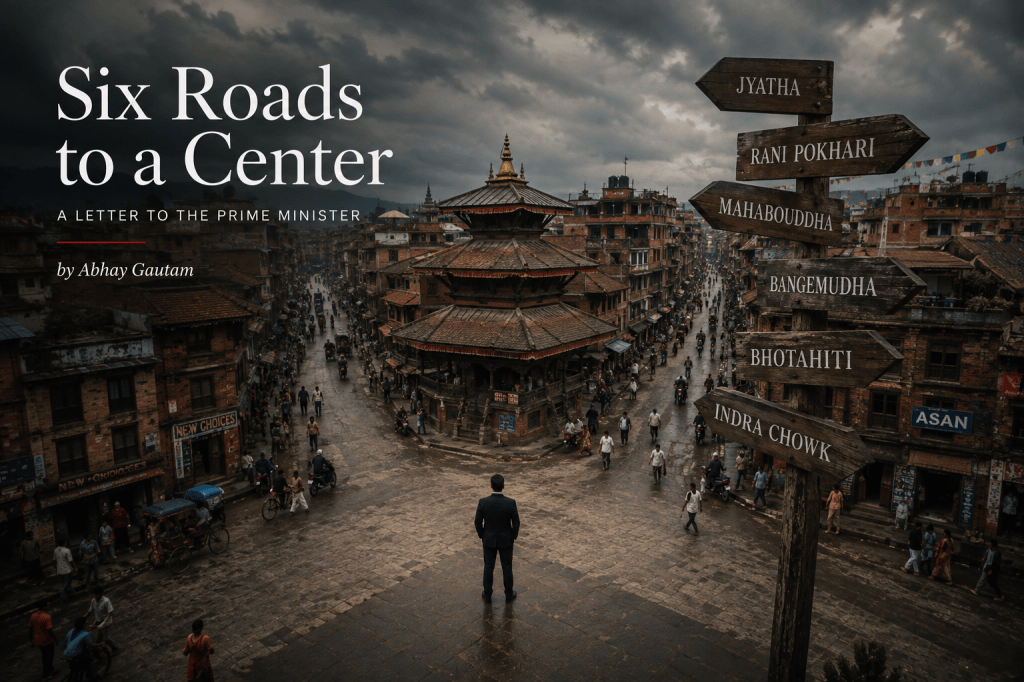
Ugratara temple sits in Asan, six roads meeting at one point, and I used to think that point was the center of everything I’m trying to write about. I was wrong. Asan isn’t the center. It’s the between — the place six different Kathmandus arrive from and leave toward, all at once, all still somehow the same city by the time they get there.
Ghantaghar ko agadi Ranipokhari — that’s the line every child in this city has chanted to decide who goes first in a game, the rhyme nobody remembers learning and everybody somehow knows. In front of the bell tower, the queen’s pond. I don’t know who decided those were the two points worth naming, out of a whole city’s worth of options, only that the rhyme settled there generations before I was born and never moved. Even our games use the map I’m using to write to you.
You know the Rani Pokhari story, or you should. Three and a half centuries ago, King Pratap Malla put his youngest son on the throne, and within days the boy was dead. His queen could not be consoled. Nothing anyone said reached her. So the king dug a hole in the earth big enough to hold a lake, and sent men to fifty-one sacred rivers and tirthas to fill it — water carried from Gosaikunda and Muktinath and further, because ordinary water wasn’t going to be enough for a grief that size. He shaped the whole basin as a yantra, a geometric instrument for peace, and set a stone elephant on the southern bank carrying the king and his sons on its back, the exact weight a father tries to give a mother to hold instead of her son. It still sits in front of Ghantaghar, the Home of the Bell if you translate it plainly, in the shadow of Tri Chandra, the Tri-Moon Campus. Nobody who actually studies or prays there thinks in translation. I do, more than I should. It’s how a familiar place starts sounding like what it actually is.
That’s what a state does with private grief when it has the resources: it turns a hole in one woman’s chest into three hundred and fifty years of public water. I didn’t have fifty-one rivers. I had a shop in Asan, across from a temple, a name on the signboard that isn’t ours anymore, and a plate of momo on Jyatha road that cost twenty rupees when my father took me and fifty now. That’s my Rani Pokhari. Smaller.
Let me walk you the six roads properly, since I’ve already gotten Asan wrong once by calling it the center. It’s six streets, and Asan only sits where they cross.
The first goes to Jyatha, to a shop called Try Again — either a joke or the truest name in the whole market, since that’s what eating there always is, the same plate, the same relief, fifty rupees now, the cheapest plate in this city as far as I’ve ever found.
The second goes to the queen’s pond, past Ratna Park beside it — the Diamond Park, though nobody who’s ever sat on that dead grass calls it that — green in patches, mostly empty, the way a nation’s actual wealth so often sits unused right beside its monuments.
The third goes toward Mahabouddha and the Trauma Centre, through the electric market, past Bir Hospital — the Brave Hospital, patching up whatever the city does to itself this week. Your metropolitan has strung the old wiring underground since I last walked this way and put in those old-style lamps along New Road, and it’s a smaller thing to thank a Prime Minister for than a throne, but I’ll thank you for it anyway. I don’t walk this street as easily as the others, though. My actual trauma doesn’t stand at the temple. It stands there, at the Centre, where my father died on a ventilator, unable to move, unable to speak, except through his eyes.
The fourth bends toward Bangemudha, past the trunk where the toothache tree used to stand — nail a coin into it, the legend goes, and the god takes the ache with him. Ugratara keeps its address on that same road, my father’s temple, and he once kept his own office in front of it too — Nine Planets, a jyotishi’s shop, where he read other people’s birth charts for a living and never once, that I can remember, told me mine. He learned Sanskrit as a boy in Tehrathum, forgot it the ordinary way a life forgets things, and relearned it as a grown man after he found Vipassana — ten days of silence at a time, sitting with everything he’d spent a life running from. A man who spent his final years walking toward stillness, in a shop that has someone else’s name on it now. He named me Abhay — fearless — and I now work for a company called Coldfeet. I used to think that was the joke life was playing on me. I don’t anymore. I think it’s just what inheritance actually looks like: you don’t escape your father’s contradictions, you get issued a new costume for the same argument.
The fifth goes to Bhotahiti, the old book market, where I once bought a novel — Ghanchakkar, a word that means, roughly, a mind spinning too fast to land anywhere — and came home saying, out loud, to my own family, that this country needs to talk honestly about its throne again. They told me I wasn’t well. Maybe, given what the book’s title actually means, I wasn’t. But I want to tell you where that particular madness actually started, because it didn’t start with me and it didn’t start with a novel.
It started on the first of June, 2001, in a palace most of us had never been inside, when a royal massacre ended a dinner and, within it, an entire dynasty’s claim to have died a natural death. Officially, we know what happened. Few in this country have ever fully believed the official version, and I won’t pretend to either, so I’ll leave it where the street leaves it: some call it a mystery, some call it a curse finally arriving on schedule — the old Gorakhnath prophecy, the one that gave this dynasty exactly ten generations on the throne before it ended, and if you count them out from Prithvi Narayan Shah, the tenth would have come due right around then. A nation doesn’t grieve a mystery the way it grieves a fact. It just keeps circling the hole where the fact should be. Seven years later the monarchy was gone entirely, abolished by the same exhausted country that couldn’t stop asking what actually happened at that table.
The doubt never actually closed, and this year, of all years, it was reopened by one of us. Sudan Gurung, the DJ who ran a nightclub before he ran a protest movement, the man most responsible for putting you in Bhimsen Thapa’s chair, took his own chair at the Home Ministry and announced, among his first acts, that every old file in this country would be reopened — the Narayanhiti file included. Whether that promise survives contact with this country’s usual patience for its own unfinished business, I don’t know yet. Nobody does. But the fact that the reopening came from the same movement that ended the last government, and not from a royalist or a historian or a court, tells you something about where the real authority to ask that question now sits.
So when Singha Durbar burned on the ninth of September — the Lion Palace, in plain English, has burned exactly twice in its history, once in 1973 for reasons nobody has ever fully explained, and again that September, in my own lifetime, while the country you now run was busy being born in the streets outside it — the whole country watched Kathmandu turn itself inside out. I remember the strange, nervous laughter that went around, the joke everyone made and nobody quite meant, that the old man himself, Gyanendra, might come walking back through the smoke to pick up what was dropped in 2008. He didn’t, of course. Lions don’t come back with a bang. They come back with anniversaries, and speeches on Democracy Day that stop just short of asking outright, and a signature campaign that started this month and is still collecting names.
The loudest voice in that campaign right now isn’t a general or a priest or anyone with a title. It’s Manisha Koirala — yes, that Koirala, granddaughter of the very man whose party dedicated itself to making sure no king ever ruled here unchecked again — standing at a podium saying, in effect, that she learned from her own grandfather that a constitutional crown is what protects this country’s soul, that a republic without one has spent seventeen years failing to give us the identity we were promised. I don’t know if she’s right. I know that when the granddaughter of Nepal’s first elected Prime Minister is the one making the strongest public case for bringing a king back, the old categories — royalist, democrat, left, right — have stopped meaning what we think they mean, and somebody in your position is going to have to say something about it before the signatures finish collecting themselves.
Because here is the actual choice in front of you. There have been two kinds of men who’ve stood where you’re standing now. One went to England as a young Prime Minister of this country, was received by a queen, fell for a courtesan named Laura Bell, and spent a fortune he didn’t personally earn on diamond rings and a house in Belgravia to keep her comfortable while Nepal waited for him to come home. The other, decades later, also became Prime Minister of this country — briefly, imperfectly — and spent the rest of his life writing psychological novels so unflinching that people still argue about what he was actually confessing. One man spent the nation’s grandeur on his own appetite. The other spent his own interior life trying to understand the nation’s.
You are thirty-six years old, with an army now. I don’t know which of those two men you already are. I know which one I’d like you to become.
The sixth road is the one I’ve been putting off, and it runs, appropriately, to New Road — despite the name, the oldest road in this whole letter — and from there straight to Hanuman Dhoka, where Prithvi Narayan Shah sat on the throne in 1768 after Kumari herself put the tika on his forehead, and where every king after him was crowned in the same courtyard, generation after generation, until the year the crowning simply stopped. That courtyard is still standing. Empty, structurally sound, and waiting for someone to tell it, definitively, what it’s for.
Because if that campaign collects its signatures, someone is eventually going to ask you the question sitting underneath all my other questions: who?
The name people reach for is Hridayendra — it translates, appropriately, to king of hearts. He was born on the thirtieth of July, 2002, the same year I was, which makes us both, by every definition anyone uses for the phrase, Gen Z. He was two years old when his grandfather seized direct power. He was five when the monarchy ended under him before he ever got the chance to sit in it. He has spent the years since studying abroad, mostly out of the country’s daily sightline, which in Nepal is its own kind of political education — you learn what a country wants from you by how loudly it misses you. If Nepal ever puts a king back in that courtyard, it may well be handing the crown to someone who has never once cast a ballot in a Nepali election, and who belongs, on paper and by birth year, to the exact generation that just finished burning down the last government for failing them. A Gen Z uprising, reaching backward for a Gen Z king. I don’t think anyone planning that signature campaign has fully sat with how strange that actually is.
His own father, by most accounts, never much wanted the job either — crowns have a way of skipping the son a country doesn’t trust and landing on the grandson it hasn’t had the chance not to trust yet. I won’t pretend to know if this country is ready to let that be the whole answer. I do know that if it ever is him, he will be exactly what you are: young enough to have spent his whole life watching this Republic fail to become what it promised, and standing there, if he ever does, only because a Gen Z uprising put him within reach of it — the same uprising that put you in Bhimsen Thapa’s chair. That is either the strangest coincidence in this country’s modern history or the least surprising thing about it. I genuinely don’t know which, and I don’t think you fully do either. Nobody’s had time to ask.
I found a hundred rupees on a dark road once, in Kirtipur, the night I climbed a wall at midnight and walked out of a ten-day Vipassana course I’d lasted five days inside — silent, starving, no phone, no money, both locked away with the rest of my belongings the day I arrived. My father spent his last years walking toward exactly that kind of stillness. I spent one night that year walking as fast as I could away from it, through Asan, into Thamel, the district built for forgetting. Same temple standing between us both times, twenty years apart, neither of us telling the other where we were actually headed. I bought a packet of wai wai and a bottle of water with that hundred-rupee note and kept walking until the city let me back in.
That’s the whole lesson I have for you, if you want one. This country keeps finding just enough, right when it’s about to run out, and it keeps walking. Whatever you decide about kings and thrones and who sits in which courtyard next — go and eat a plate of momo on Jyatha road. Fifty rupees. Cheapest plate in Kathmandu, as far as I can tell, and it hasn’t let the city’s cruelty touch it yet. I would like, more than almost anything else I could ask a Prime Minister for, to watch you eat there and mean it.

 Abhay's blog